
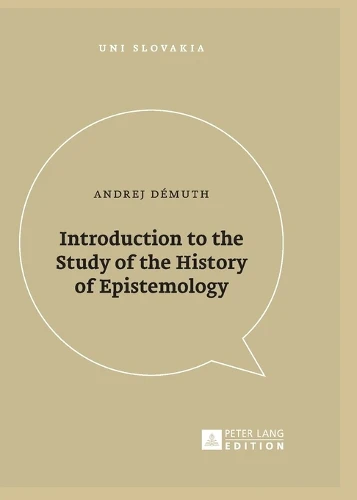
Introduction to the Study of the History of Epistemology: 1 (Uni Slovakia: Humanities, Social Sciences and Law for Universities
The text presents nine basic types of the classical philosophical perception of the problem of knowledge: the atomistic and causal theory of perception, Platonism, Aristotle's doctrine, scepticism, rationalism, sensualism, Kant's theory of knowledge, phenomenological-existential, pragmatic, and (post)analytical perceptions of knowledge.
The text is structured in chronological and ideological order and presents nine basic types of the classical perception of the problem of knowledge through an analysis of the atomistic theory of perception, Platonism, Aristotle’s doctrine, scepticism, rationalism, sensualism, Kant’s theory, phenomenological-existential, pragmatic, and (post) analytical perceptions. The proposed work aspires to be an introduction (not a complete presentation, neither in the number of types, nor in a full interpretation) and a basis for the reader’s interpretations which is reflected in the structure of the text.
Product Information
Product Information
Shipping & Returns
Shipping & Returns
Description
The text presents nine basic types of the classical philosophical perception of the problem of knowledge: the atomistic and causal theory of perception, Platonism, Aristotle's doctrine, scepticism, rationalism, sensualism, Kant's theory of knowledge, phenomenological-existential, pragmatic, and (post)analytical perceptions of knowledge.
The text is structured in chronological and ideological order and presents nine basic types of the classical perception of the problem of knowledge through an analysis of the atomistic theory of perception, Platonism, Aristotle’s doctrine, scepticism, rationalism, sensualism, Kant’s theory, phenomenological-existential, pragmatic, and (post) analytical perceptions. The proposed work aspires to be an introduction (not a complete presentation, neither in the number of types, nor in a full interpretation) and a basis for the reader’s interpretations which is reflected in the structure of the text.